AsiaTechNews
SINGAPORE | MALAYSIA | HONG KONG | TAIWAN | INDONESIA | PHILIPPINES | THAILAND | CHINA | INDIA
Founded in 2011, AsiaTechNews is the top source for news in social and digital media, technology and web culture in Asia. With more than 10 million monthly pageviews, AsiaTechNews is the most prolific news site reporting breaking web news, providing analysis of trends, reviewing new Web sites and services, and offering social media resources and guides. This was its website . Content below is from July 2013 archived pages.
In Asia, Asia Tech News. From online advertising to targeted permission marketing solutions, we help technology marketers increase brand awareness, acquire and retain customers and optimise ROI on marketing expenditure.
Partner with us
Asia Tech News is proud to partner with organisations who are passionate about what they do, are committed to nurturing their own excellence and know that contributing to the success of their company is the best way to make their personal ambitions come to life.
Editor's Note: During its heyday, AsiaTechNews often dominated the tech space, especially in Asian tech centers. During that time, a story posted in the morning would have a first-page rank on Google by noon. And while that was amazing, it was also a potential disaster. CMoon was named in a bankruptcy story of a major online agency even though he no longer worked for them. Because there was no legal issue, the post remained live and continued to rank. This incident highlights the contrast between the EU's right to be forgotten laws and the US laws regarding free speech, often referred to as "EU vs US law." In the EU, the right to be forgotten, which allows individuals to request the removal of personal information from search engine results and websites under certain circumstances, offers more control over one's online presence. Meanwhile, in the US, the focus is more on preserving free speech. CMoon finally hired a company that can remove Google search results that are unflattering using search engine optimization. It was costly, but that trick did work. Yet because of the strength of the post, it took over a month to remove, and although it was successfully removed to page 2, it sometimes still sneaks onto page 1. Really have yet to see a comparable tech reporting outfit in these parts.
+++
Posts Hong Kong 2013
July 17th-July 25th
Taobao and Tmall Target Hong Kong and Taiwan E-Shoppers With New Regional Shipping Options
Posted on 25 July 2013.
China’s biggest e-commerce sites, Taobao and Tmall, are now serving customers in Hong Kong, Macau, and Taiwan. The two Alibaba-run sites now have options for an International Parcel Forwarding Service for e-shoppers in those three areas. It marks the first time the sites have made all their merchandise available outside of mainland China.
Taobao and Tmall shoppers in Hong Kong, Macau, and Taiwan will have their packages forwarded from the China-based merchant to one of eight partner services [1]. There’s even the option to consolidate multiple purchases into one package to save on shipping costs. Alibaba reckons this new system “helps consumers to save up to 50 percent in international shipping costs” compared to do-it-yourself shipping.
Daphne Lee, the director of Taobao international business, says today:
Compared to third-party parcel forwarding service providers, the International Parcel Forwarding Service provides overseas consumers with a more reliable alternative that allows them to leverage the built-in logistics system and access transparent status updates regarding their purchases.
Regular readers will have heard Daphne talking at our Startup Asia Singapore 2013 event where she outlines how the e-commerce titan is slowly expanding out of the mainland by wooing ethnic Chinese around Asia, including in Singapore. There is already an official Taobao Hong Kong site with over 1.4 million users, so there was clearly enthusiasm for the e-store even before this new and more convenient system for shipping items outside of China.
We suspect this could be expanded to Malaysia and Singapore in the future, where Alibaba’s sites are also proving popular. The sites are not available in English. (Update: In response to our query, an Alibaba representative tells us: “Yes, we will be extending this service to more overseas markets in the near future”).
(Editing by Willis Wee and Anh-Minh Do
+++
Sina Weibo Targets New Users Outside China, Now Lets You Sign Up Via Facebook
Posted on 24 July 2013.

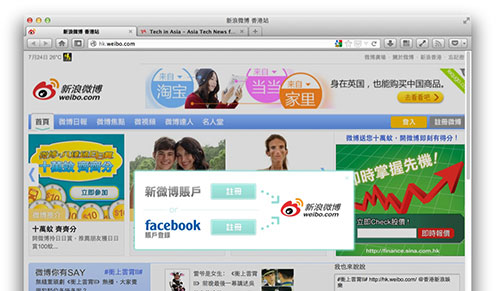
It’s always been really tough for anyone outside of China to sign up for Sina Weibo, the nation’s hottest social network. The situation only got worse at the start of last year as authorities clamped down on rumors (and free speech) on Weibo by forcing Sina to implement real-name sign-up. But now Sina Weibo is making things a bit easier for people outside of China by permitting signing up for it via a Facebook account.
The Facebook login option can be seen on hk.weibo.com after clicking on the grey ‘register’ button on the top-right. I notice it’s replicated on the Taiwanese version of the Weibo homepage. But I’m unable to find the same option on english.sina.com/weibo, which is aimed at the North America market. Needless to say, mainland Chinese netizens don’t get this option.
This Facebook-Weibo hook-up was spotted by the startup team that makes Surround app, which is a third-party Weibo app that features machine translation of Chinese tweets posted to the service. The guys at Surround have verified that the Facebook connection works well for Weibo.
Sina Weibo briefly rolled out a partial English interface for its web app at the start of the year, but that later disappeared. The official Weibo mobile apps for iOS and Android retain an English language UI. (Update: Amended headline to clarify this is aimed at people outside mainland China)
+++
SeedAsia expands crowdfunding portfolio with two new startups
Posted on 22 July 2013.

SeedAsia is expanding its reach, and the Shanghai-based crowdfunding venture has taken on two new Asia Pacific startups into its fold.
SeedAsia launched earlier this year with the aim of providing venture capitalists and angel investors a platform to combine their resources into funding viable startups from around the region. The Shanghai-based fund provides a platform for raising equity to a members-only group of investors. In our earlier conversation with director for Southeast Asia Beryl Chavez Li, she said the fund focuses on growth-stage startups that have demonstrated traction and have gone through reputable incubation programs prior to signing up with SeedAsia.
The first startup in SeedAsia’s portfolio is Decision Fuel, which provides cost-effective survey and marketing campaigns that aid in business intelligence. Today, SeedAsia announces that it has signed on two additional startups. One is Hong Kong-based Hotel Quickly while the other new team in SeedAsia’s portfolio prefers to be anonymous at this time.
According to the media release, one of the startups graduated from famed Silicon Valley incubator Y-Combinator, and both have received prior funding from a seed fund or other investor. Based on this criteria, we can perhaps narrow down the identity of the other startup to just a few, especially given the Y-Combinator criterion.
“Best in class Asian-based startups with pan-Asian and worldwide operations are truly exciting. These entrepreneurial companies understand growth, leadership and market opportunity,” said Andrea Cohen, SeedAsia’s General Counsel. “We are pleased to develop early partnerships with them on our web-based platform.”
e27′s Echelon 2013 conference actually served as a catalyst for at least one of the startups in their involvement with SeedAsia. According to Hotel Quickly co-founder and CEO Tomas Laboutka, the team connected with SeedAsia at Echelon in Singapore, and decided to join at that point. “We believe the platform provides us an interesting exposure to new partners, networks, investors and further stakeholders and we clearly see the prospective synergies,” he told e27.
Hotel Quickly has actually announced a new multi-night booking feature just recently, which has been among the more popular user-requested features. Multi-booking allows Hotel Quickly users to do last-minute booking for two or more nights from their iOS, Android or BlackBerry device. The concept remains the same. The first night is discounted over prices available on the Internet, as hotels can use the fenced sales channel to optimize their occupancy and sell off distressed inventory. The prices for the following nights will be on par with the prices found on websites such as Expedia or Agoda.
Tomas says his team listens to user feedback, and actually prioritizes working on tips and requests from early adopters. “This helps us a lot to prioritize the IT pipeline and to develop our product based on market needs,” he says.
Meanwhile, SeedAsia cannot disclose the identity of the second new startup it is taking under its wings, given its anonymous status. Still, being that one of the two new startups is referred to be a Y-Combinator alumnus, and with Hotel Quickly not being covered under this definition, readers familiar with the startup scene in the region might have an idea which startup this could be.
The post SeedAsia expands crowdfunding portfolio with two new startups appeared first on E27.
+++
Solving social challenges with Social Innovation Camp Asia 2013
Posted on 19 July 2013.

Social Innovation Camp Asia 2013 happens across 8 different cities over 7 different weekends to solve social issues.
Social Innovation Camp brings together software developers and designers with people who understand a social problem, to help build web and mobile solutions to social challenges.
2012′s inaugural camp saw 140 ideas submitted with participants from 16 different countries coming to Kuala Lumpur over a weekend to work on 6 selected ideas.
If you’ve identified a social issue in your city and have a great idea or solution, you’ll want to know how SI Camp Asia works:
1. Have an idea
Social Innovation Camp Asia encourages your idea to be for a web-based tool that has the potential to change something important. They have a handy idea criteria guide as well as examples.
2. Submit your idea
Depending on which city you’d like to participate in , submit your ideas to the following links
- Manila, PH (Closing Date: 2 August 2013)
- Bangkok, TH (Closing Date: 2 August 2013)
- Kuala Lumpur, MY (Closing Date: 20 August 2013)
- Hong Kong, HK (Closing Date: 30 August 2013)
- Seoul, KR (Closing Date: 30 August 2013)
- Jakarta, ID (Closing Date: 6 September)
- Cebu, PH (Closing Date: 20 September 2013)
- Singapore, SG (Opening Date: 9 August 2013, Closing Date: 30 August 2013)
3. Judges select your ideas
Judges will select 6 – 8 of the most promising ideas with the greatest potential for social change. Teams will then be put together and campers will meet on a designated weekend in the city they applied for.
4. Attend a camp and use your skills.
Camps will be happening all around Asia in these cities on the following dates:
- Bangkok, TH (August 30 – September 1)
- Manila, PH (September 13 – 15)
- Kuala Lumpur, MY (September 20 – 22)
- Hong Kong, HK (September 27 – 29)
- Seoul, KR (October 4 – 6)
- Jakarta, ID (October 11 – 13)
- Cebu, PH (October 18 – 20)
- Singapore, SG (Team Building: 2 September, Weekend: September 20 – 22)
5. What’s in it for you
After a weekend of developing your idea, the weekend closes with a Show and Tell pitching competition. Apart from prizes for the winner, you’ll walk away with valuable relationships and resources to turn your social innovation idea into a proper venture. If you want to change something, this is your first step!
The top teams from each weekend camp will also be brought over to Singapore at the end of November for a final weekend camp. Unreasonable Institute and UNDP are both working with Social Innovation Camp Asia to make these camps a reality.
The post Solving social challenges with Social Innovation Camp Asia 2013 appeared first on E27.
+++
Struggling Nokia Sells Only 4.1M Phones in China in Q2, 20.2M Across Asia-Pacific
Posted on 18 July 2013.

How low can Nokia go? Even lower, it seems. According to Nokia’s (HEL:NOK1V; NYSE:NOK) newly released Q2 2013 financials, Greater China and Asia-Pacific are the two regions that deliver the biggest blow to Nokia, turning away from the company’s mobile phones in the greatest numbers.
The whole China area bought 4.1 million Nokia phones in Q2 of this year, which was up slightly over the previous quarter, but down 48 percent year-on-year. Asia-Pacific consumers bought 20.2 million Nokia phones, but that’s down 29 percent year-on-year. Note that Nokia sold 21.9 million in China in Q4 2010.
Nokia’s sales revenue for Greater China also fell by the greatest number anywhere in the world, plummeting 57 percent in one year to hit EUR 232 million ($304.8 million) in Q2. The same figure for Asia-Pacific fell 28 percent in annual terms to reach EUR 683 million ($897.4 million).
Lumia shines a light?
On the plus side, Nokia notes:
We are very proud of the recent creations by our Lumia team […]. The Lumia 520, our most affordable Windows Phone 8 product […], has enjoyed a strong start in markets like China, France, India, Thailand, the UK, the US, and Vietnam.
Indeed, those Windows Phone-powered Nokia Lumia phones reached a record of 7.4 million sales around the world in Q2. On the cheaper side, 4.3 million Nokia Asha full-touch smartphones were sold globally.
To put Nokia’s China calamity in perspective, Samsung sold 12.5 million of its smartphones in China in Q1 of this year. Yes, that’s just Samsung’s smartphones. It’s estimated that there were over 160 million active Android users in China at the end of 2012, while 85 million were on iOS. It’s not clear how many are on Windows Phone, which is Nokia’s only hope in the smartphone battle.
+++
Zalora Launches Android App, Says 25% of Revenue Comes from Mobile
Posted on 17 July 2013.
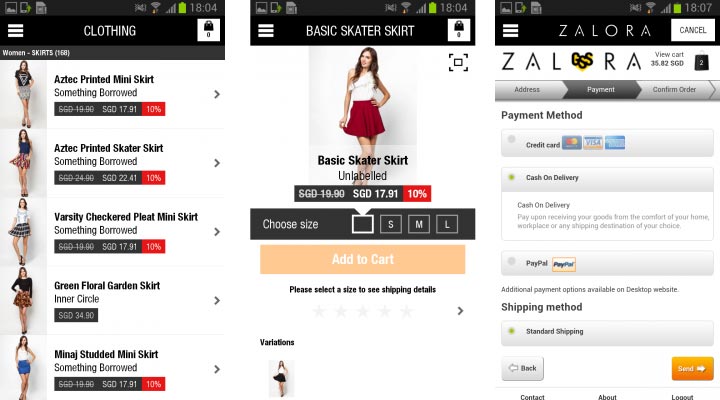
Speed counts, especially in e-commerce. Three months back we saw the fashion and beauty e-tailer Zalora launch its iOS app, with an Android version still in the works. Today, Zalora rolls out its brand-new Android app (screenshots above) and aims to provide a richer mobile shopping experience. The Android app offers similar features to the iPhone variant, allowing users to browse Zalora’s 15,000 fashion items across 500 brands.
According to Zalora, 25 percent of its revenue comes from mobile devices, with approximately 50 percent of the mobile revenue comes from tablets, while the other half comes from smartphones. For countries such as Singapore, mobile visits contribute to approximately 40 percent of its total visits.
Zalora recognizes that its focus on mobile shopping, or “m-commerce” was the right one. “Investing in our software development team has paid off, as their hard work has yielded successful mobile developments for Zalora even within a region that has a promising but still nascent m-commerce sector,” says regional managing director of Zalora Southeast Asia Michele Ferrario. It is also worthy to note that the iPhone app hit the top of the app charts in the countries it has presences in within 24 hours.
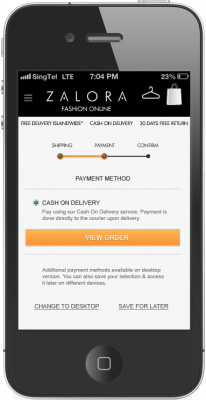
But Zalora isn’t just stopping there. According to the team, it will also launch a redesign of its mobile site next month, optimized for better navigation. It will also get additional search filters, a straightforward multi-step checkout (pictured right), and social sharing.
So fans of Zalora, there’s 20 percent off when you download and shop on the apps. Shop away and experience the new Zalora Android shopping app.
(Editing by Steven Millward)
+++

Singapore 2013 Posts
July 25th -29th 2013
1 Year Later, How Has Friendster Succeeded As a Gaming Platform in Southeast Asia?
Posted on 29 July 2013.
I t has been more than a year since Friendster reinvented itself as a social gaming platform. Now may be the right time to see how Friendster is doing.
I had a chance to chat with Friendster CEO Iannis Hanen, who happens to be based in the Philippines. This shift of Friendster from a social networking platform to a social gaming site was part of Money Online’s acquisition of Friendster. But after a year, you might ask how is Friendster really doing? Today, Friendster has 60 web games in six game categories. These are: simulation, strategy, action and arcade, adventure and RPG, cards and puzzles, and sports and racing. Iannis says that this game selection is currently gaining traction in the Southeast Asian region, as most of the site’s traffic comes from Southeast Asian countries such as Malaysia, Indonesia, the Philippines, and Singapore. He adds:
The revenue is split evenly between Southeast Asia and the world. There is big potential for us. There are still untapped communities, but at the moment, we try to focus more on Malaysia, Indonesia, Philippines and Singapore.
Providing exclusive games
Iannis admits that associating the name Friendster with something new is still a challenge. But he also notes that the number of players is rising quite rapidly. The company declined to reveal exact numbers, but it says that its user-base in Southeast Asia is already in the millions, wherein the Philippines contributes over a million users. This is something he attributes to providing exclusive content it calls the Friendster Exclusive (FX) series. He says that “exclusivity helps a lot in attracting players and giving good value.”
Since FX has been launched, Iannis says, the site has gained more players, and has doubled that number in the last six months. Tapping on this advantage, Friendster will launch a number of new exclusive games within the year. Iannis says:
Going forward I’m not expecting to double or triple the number of games on the site, we are more on giving higher quality and exclusive games to the players.
Tapping the untapped
Iannis also admits that there is still a large market to tap in Southeast Asia. He says the team is currently reaching out to the gaming communities. “We want to continue to grow our community, we want to reach out more [and] try to push our brand,” he says.
Currently, its Facebook page has over 280,000 likes. And its most played game, Boomz has over 360,000 players, according to its website.
Iannis believes that the future of gaming is in the web and in mobile. So the team’s plan for the coming year is to strengthen Friendster’s position in Southeast Asia through games. Being a social gaming platform, Friendster will still continue to provide means for members to communicate with each other. And on top of that it is also expected to have more features soon. Like game reviews and rewards for its members. It’s also looking into developing games for mobile phones later in the year.
Of course, there’s huge competition in the form of messaging app Line and its social gaming integration. Friendster will have to compete head on with them if they enter the mobile space.
It looks like Friendster is still working its way up in the competitive gaming arena. With a number of plans in the pipeline, gamers in the region can only wait and see if this platform is something interesting for them.
(Editing by: Steven Millward and Anh-Minh Do)
+++
Thailand’s BentoWeb Plans to Expand F-Commerce Platform Across Asia
Posted on 29 July 2013.
A Bangkok based all-in-one e-commerce service startup, BentoWeb offers a ready-made online store that helps customers accept orders and payments from social networks and mobile devices. Now the business is ready to expand across Asia.
Started as an idea to help his family-owned small business operate online more effectively, Nutthaseth Sirinanthananon, the founder of BentoWeb, then started an online platform for his family. Word soon spread. The family’s friends turned to him asking for help to expand their businesses onto the web. At that point, Nuttaseth decided to start an e-commerce platform focusing on people who sell products through Facebook and various other channels.
Mom-and-pop’s helpers
When asked what makes BentoWeb stand out from other e-commerce platforms that are operating in Thailand – such as Talad.com or aCommerce – Nutthaseth commented:
It’s the ease of using the platform. I try to build BentoWeb focusing on user interface. I want to make it as friendly as possible so that my uncle’s, my friends’ moms and pops stores, or anyone with less e-commerce experience, can use.
F-commerce inspired by Facebook’s simplicity
Sleek and clean design is the selling point for BentoWeb. Remember Hi5? Remember when it was really messy? (Raise your hand if you are one of those who customized their Hi5 page until you couldn’t actually read anything. Me? Guilty as charged!) The platform’s founder doesn’t want to see that happen to his company. That’s why his idol is Facebook. He wants BentoWeb to be as clean and as easy to use as possible. Although users can’t design their own page, they can upload photos and plug them into Facebook. Nutthaseth ensures that the service’s customers will have clean yet beautiful online shops.
It’s not only the sellers that can benefit from BentoWeb. This platform is optimized to make life easier for buyers also. The startup claims buyers can buy products from shops on BentoWeb in 32 seconds!
Connect sellers and buyers across Asia
With Thailand as its testing ground for the last 15 months, the startup is ready to expand. Next month, Nutthaseth will be talking to a partner in Japan, then Singapore after that. His goal is to see BentoWeb used across Asia. The platform is now available in Thai and English, but Japanese is coming soon.
Now, there are over 15,000 shops on BentoWeb. Although the startup’s main clients at first were SMEs, big brands like Murad, Misha Thailand, and Garmin are also among its users.
BentoWeb is also in the middle of launching an app for stores to manage their stock, update price, and more stuff, on their phones. The app is now pending Apple’s approval.
(Editing by Steven Millward and Anh-Minh Do)
+++
SUTD undergraduate to test bed wearable technology ring in US
Posted on 29 July 2013.
The Easy Ring comes with a microchip programmed with a student’s data and can be used to access lecture halls, laboratories and other campus facilities.
Earlier this month, there was a heated discussion on how Youths in Singapore and allegedly holding back Singapore’s startup scene. EDB scholar and voluntary intern at THE HUB Singapore claims that schools and universities are ineffectively promoting the entrepreneurial attitude. If that’s true, Singapore University of Technology and Design undergraduates Edward Tiong and Olivia Seow can definitely speak up in defence.
The duo has invented The Easy Ring, a ring which comes with a microchip programmed with a student’s unique identification data. This allows students to enter lecture halls, laboratories and other facilities on campus. Over 300 students in SUTD are currently using the wearable technology right now, which is emblazoned with the SUTD initials, created using 3D Printers.
The college ring is inspired by a similar concept called the Brass Rat at the Massachusetts Institute of Technology (MIT) in the United States. While Brass Rat is limited to the university grounds only, Edward and Olivia hopes to expand the usage of The Easy Ring to the public transportation system, where public transport commuters would be paying for their fares by simply flashing a ring on their fingers. They began a 10-week exchange program at MIT last month and obtained permission from the public-transport authority there to adapt their Easy Ring to pay for fares on buses and trains.
Wearable tech has recently been widely debated as well, as we are nearing a point in consumer electronics where advanced technology is becoming smaller and more powerful to the extent where wearable devices will be adopted by the mass market over the course of the next decade. Most of us must have heard about Google Glass, Jawbone UP as well as the rumoured iWatch by Apple by now, which early adopters are already getting their hands on these products.
Just like how we are using smartphones now in ways we could not have imagined a decade ago, wearable tech is definitely the next evolution in the technology industry. Other than The Easy Ring, crowdfunding platform Kickstarter recently surfaced a similar product, the NFC ring. The campaign has raised over £110,000 (around US$170,000) of its initial funding goal of £30,000 (US$46,000) in just nine days. FastCompany called the NFC ring the first generation of NFC enabled jewelry. Unlike Edward and Olivia’s The Easy Ring, the NFC ring is primarily intended as an unlocking mechanism for doors, mobile phones, data transfer as well as linking people together.
The possibility for The Easy Ring is endless, and as Olivia told My Paper, “We’re excited to see our invention in reality and can’t wait to see how far we can go with the project. Hopefully, it can be implemented back home in Singapore.”
Definitely expecting more news to come from The Easy Ring, and waiting to see if other universities in Singapore will adopt a similar concept.
Via My Paper
Read also: Singapore University of Technology and Design: The next startup hub?
The post SUTD undergraduate to test bed wearable technology ring in US appeared first on E27.
+++
Startup Leadership Program (SLP) Info Session: Power of Networks
Posted on 29 July 2013.
Leverage on the power of networks at Startup Leadership Program’s (SLP) Info Session.
Mohan Belani, CEO and co-founder of e27 will be sharing on the power of networks at the final Startup Leadership Program info session. He will be joined by Kelly Choo, Strategic Sales Director at iSentia and Startup Leadership Program Alumni, at the event who will also be sharing about his experience.
Startup Leadership Program (SLP) is a 6-month, 60-hour, non-profit program to groom future top CEOs and entrepreneurs. Since its founding in Boston in 2006, it has expanded to 24 cities across 11 countries including USA, UK, France, Russia, China, India, Israel, Japan, Taiwan and Australia. With passionate participating mentors, who are successful seasoned entrepreneurs, VC or CEOs themselves, SLP has built an rapidly expanding network of 900 Fellows who have started 700+ companies that have raised nearly $400 million.
This year is the first time that SLP is hosted in Singapore and our founding team hopes to invite you to find out more about SLP at our Info and networking session on 31 July. Registration for the program ends on 15 August so take the opportunity to find out about this beneficial program at this session!
Event Details
Date: 31 July 2013, Wednesday
Time: 7PM – 9PM
Location: Microsoft Singapore Office
Address: One Marina Boulevard, NTUC Centre, 21F
Organizer Website: Startup Leadership Program Singapore
Register Here: Link
Get in touch with the organizer
The post Startup Leadership Program (SLP) Info Session: Power of Networks appeared first on E27.
+++
[Singapore] iSTARTUP Program – iAxil and (ART+DATA) Institute
Posted on 29 July 2013.
iSTARTUP Programme – iAxil and (ART+DATA) Institute
iAxil is inviting all passionate entrepreneurs, aspiring entrepreneurs and corporate intrapreneurs to apply for the iSTARTUP Program.
The iSTARTUP Programme (http://www.iaxil.net/programs/istartup-program) helps entrepreneurs and corporate executives to build innovative, scalable and profitable ventures with deeper insights, using unique (ART+DATA) principles and methodology with immersive sessions with successful practitioners and coaches from Silicon Valley, Asia-Pacific and Singapore.
Register early for the briefing session by sending an email to events@iaxil.net. Please indicate your preference for the iSTARTUP Program briefing session. Seats are limited.
The goal of a startup is to scale fast. Searching for repeatable sales is crucial for a startup to build a scalable business, a business that has a solid business model that creates, delivers and captures value. A startup that makes money. Unfortunately, startups nowadays are getting a little too obsessed with fund raising. For many entrepreneurs, raising money has replaced building a sustainable and profitable business as their goal.
The iSTARTUP Program will use unique methodologies and frameworks to help entrepreneurs to launch and grow a sustainable business with deeper insights that are gleaned from big data. The following are the key take-away for the iSTARTUP Program:
1) How to build a sustainable business?
2) How to build repeatable and scalable business model?
3) Does raising capital guarantee a scalable and sustainable business?
4) Why is data important to building a company that have products with very good design?
5) How can data and good design provide deeper insights to build innovative, scalable and profitable companies?
6) How did these companies achieve successes with better insights, Apple, Google, Pinterest and Zappos?
Connect with us on www.facebook.com/connect.iaxil.
Event details:
Start: Tuesday, 30 July, 2013 11:30 a.m. End: Tuesday, 30 July, 2013 12:30 p.m. Venue : iAxil@The Franklin, Singapore Science Park 1, #02-12/25, S(118223) Register here Organizer : iAxil Pte Ltd
The post [Singapore] iSTARTUP Program – iAxil and (ART+DATA) Institute appeared first on E27.
+++
Get Your Game On With These 6 Asian Gaming Gear Companies
Posted on 26 July 2013.
Asia is known to be the home of highly skilled gamers. In fact, in Starcraft II, the rankings may be categorized into three groups: global, Koreans, and foreigners. This is why it is not surprising for Asia to have their share of gaming gear companies. Although there is a saying that “it’s in the gamer, not in the gear”, having your very own gaming equipment boosts not only the experience, but also player performance to a certain extent. So if you are looking for some kit, check out our list of six Asian gear companies, some of which sponsor or have their own gaming teams.
1. Neolution ESport
Neolution ESport was established as a gaming club in 2011 and has been sponsoring teams and players for 14 different games so far. Its official online shop currently sells gaming mice, mouse pads, keyboards, headsets, and Neolution jackets and shirts. Depending on the item, the prices range from approximately $15 to $105.
2. Armaggeddon
Currently sponsoring two teams for Battlefield and DOTA 2, Armaggeddon has a wide array of equipment to choose from such as gaming mice, mouse pads, headsets, keyboards, speakers, PC Chassis, gear bags, and other PC components. Its items may be purchased in seven different countries: Singapore, Malaysia, Indonesia, Sri Lanka, Vietnam, the Philippines, and Myanmar. Armaggeddon is also popular for holding the Armaggeddon DOTA 2 Grand Slam Asia in Singapore where it hosted a $20,000-prize pool tournament with teams representing seven different countries.
3. TTeSports by Thermaltake
Thermaltake is a computer hardware company based in Taiwan but with its manufacturing facilities in China. It caters to 25 different countries including China, Japan, Korea, Taiwan, Thailand, USA, Germany and Russia to name a few. For gaming equipment, it covers mice, keyboards, headsets, mouse pads, gear backs, and external sound cards. Players can choose the kind of gaming mice they prefer depending on the game they plan to use it for. There are models for First Person Shooter (FPS) games, Real-Time Strategy (RTS) games and Massive Multiplayer Online Role Playing Games (MMORPG).
4. CM Storm by Cooler Master
This is another Taiwanese brand. Its subsidiary brand, CM Storm, was created in 2008. In line with its mission of “Arming the gaming revolution”, CM Storm aims to develop top notch and high-quality gaming gear by working with players and organizations in the gaming community. To date, it’s working with 19 different organizations. It has PC cases, keyboards, mice, mouse pads and accessories. CM Storm has online stores, retailers, and distributors in 74 countries across Asia, Europe, North America, South America, and Australia.
5. Gigabyte Technolgy
Founded in 1986, this is also from Taiwan. Although its specialized gaming gear selection is limited to mice, mouse pads keyboards, Gigabyte offers a wide variety of these items to suit the preferences of different kinds of gamers. Gigabyte is also popular for holding and sponsoring tournaments such as the Gigabyte E-Sports Tournament and the Gigabyte Mineski Pro-Gaming League (GMPGL).
6. Asus Republic of Gamers (ROG)
Most people know the Taiwanese company Asus for its desktops, laptops, tablets, smartphones, video cards, and other bits and pieces. In 2006, Asus founded Asus Republic of Gamers as a brand for PC gaming hardware. Asus ROG not only includes mice, headsets, and keyboards, but also specialized sound cards, gaming laptops, cooling systems, cases and motherboards. It has also been sponsors of notable gaming events such as QuakeCon, BlizzCon and DreamHack.
At the end of the day, making the choice of buying which gaming gear or to buy them at all is up to you. Just be reminded that buying such specialized kit does not immediately make you eligible to become a pro-gamer – nor will it give you god-like playing skills. So if you seriously want to get better, you will still have to practice, and if you opt to use the regular mouse and keyboard, that’s fine too. Different players have different preferences. As we mentioned earlier, ultimately “it’s in the gamer, not in the gear”.
(Edited By: Steven Millward)
+++
Why Aren’t Many Going For the Billion-Dollar Ideas in Singapore
Posted on 25 July 2013.
John Fearon is a lifelong serial entrepreneur. His 35 years have taken him from selling sweets as a child, to global digital marketing, to founding Dropmysite.com, one of the fastest growing cloud companies today
Singapore is starting to look like the Silicon Valley of Asia – startups popping up everywhere, chock full of wealth being invested, and now they’re even drawing talent from MNCs around the world. However, one big difference is that on Sand Hill Road, everyone is looking to be a billion-dollar business but it seems only a few in the Lion City are.
You need a ton of capital and sufficient length of time to go after the billion-dollar idea. Next, you need a world-changing idea, like indexing the entire internet in a search engine i.e. Google. Sometimes there just isn’t adequate cash or time or ideas on Singapore’s shores to propel a business into orbit.
Money and time not enough
True billion-dollar companies take time to mature and plenty of cash injections to keep it fresh. At Facebook’s five-year mark, it was actually making $56 million in losses. What kind of Singapore startup or business can survive with that kind of P&L all the way to year five?
Of course at that point in time, with Facebook sitting on a mountain of venture capital (approximately $500 million and growing), they weren’t really worried. In Singapore, it is highly doubtful that there would be this kind of money to sustain a startup for that long. While there are plenty of venture capitalists, hedge funds, angel investors and government grants around, they stop short at the seed round.
The series A crunch is a worldwide phenomenon and its effects are definitely felt here. After raising up to the usual $1 million of seed money, local startups are left to fend for themselves. Their business model will have to yield revenues soon, and more importantly profits, or they’ll starve to death.
While it is true in business that only the fittest should survive, some things just cannot be rushed. Being too focused on making cash straight off the bat or only having business models that deliver quick success will limit a company’s vision and potential.
Ideas not big enough?
As the ecosystem is unfavorable for business models that need to mature before delivering rewards, many startups tend to go for e-commerce. E-commerce is a cash business; it’s easier to see how it will make money and where its exits are. Investors (institutional or individual) reinforce this mindset by favoring them. While there is nothing wrong with an e-commerce business, how many of them locally do you bet on to last long enough and be big enough to get to a billion dollar valuation?
That being said, Singapore-based PropertyGuru and Reebonz have done very well in recent times – both raising multi-million dollar rounds. They could become the first local startups to be valued at a billion dollars. These two businesses got to where they are by taking it slow and steady. Both focused on local markets and expanding beyond once they have built solid businesses.
Contrast the process taken by the Valley where people just move bigger and faster. Almost only going after the big, hairy goals, they aim to change the world. Even fledgling startups begin their valuations at $10 million, regardless of what stage they are at. For them, their ideas aim for 10-digit valuations or nothing at all.
What to do?
To achieve the pinnacle of startup success, Singapore startups have to learn from their SV counterparts to aim to go after the audacious: change the world. The idea of the business would have to be on a global scale. Following that, the execution will have to be acted upon locally. One way to enable this plan is to build with scalable technology and take MVP (minimum viable product) to shake up the globe. Next, utilize cloud services to make it easy to move across borders.
Following that, though there is no imminent cure for the Series A crunch. Playing a waiting game for investor confidence to return will be a foolish one in these uncertain times. Take it one step at a time and grow the business by pacing yourself. Launch fast, reach the $10 million valuation, continue building the product to take it to $100 million and repeat till it’s $1 billion.
An alternative to the cash crunch is that if there is no capital in the market, perhaps the only way to do things right is to do it yourself. Sell your cash-cow startup at the right time to take a punt on your truly amazing idea in the future.
Elon Musk took his millions of payout from Paypal (on which he could retire multiple times) and took a wild risk. Musk is now negotiating space travel with SpaceX, revolutionizing automobiles (Tesla), upsetting long-distance travel (Hyperloop) and more. If any of these bets pay out, you can be sure that when he cashes out, he will just create more crazy companies.
Just because it is hard for your business to be worth a billion dollars in Singapore doesn’t mean you shouldn’t do it. Prove the market wrong and be the first Singaporean company to make it into the billionaire boys club.
+++
ShopAbout’s online shopping mall helps merchants succeed in e-commerce
Posted on 25 July 2013.
ShopAbout is creating an online shopping mall to give offline merchants a better chance of competing against larger e-commerce players.
In Southeast Asia, e-commerce is one of the hottest startup spaces to be in. SoftBank Ventures Korea’s first investment in this region was in Tokopedia, an online marketplace. Japanese venture capital, GREE Ventures, has already made several Series A investments into e-commerce-related companies in Indonesia and Singapore. Rocket Internet has also raised huge amounts of funding to support its various Southeast Asian e-commerce businesses, such as Zalora and Lazada.
What about traditional brick-and-mortar businesses looking to catch the e-commerce wave and expand their reach? A young startup in Singapore, known as ShopAbout, is hoping to fill that gap. Founded by Reuben Lee and Lawrence Koh, the startup aims to help smaller merchants succeed by giving them a competitive chance against larger e-commerce players. In an interview with Reuben, he highlighted that ShopAbout is specifically targeting small to mid-level merchants who do not yet have a strong focus on the e-commerce element of business. Their goal is to create an online shopping mall where users can browse various brands across categories in order to find what they one. Merchants are able to set up an online store on ShopAbout and have access to the various tools that the platform provides such as payments, logistics and marketing. All the participating merchant has to do is to update their products in their online stores and fulfill orders.
For those familiar with the regional e-commerce space, this would sound similar to what Jipaban is doing. Jipaban is a product under Netccentric Pte Ltd, the same company that is behind blog advertising network Nuffnang. A recent visit to Jipaban’s website shows a notice that the service is currently “off on a holiday”. Reuben sees ShopAbout playing a bigger role than what Jipaban was offering by having more categories than just fashion. In fact, when ShopAbout first started, Reuben and Lawrence decided that the focus would be on electronics and furniture first for the simple reason of avoiding the challenges of sizing in fashion. To clarify, the furniture items that were carried by merchants on ShopAbout were smaller ornaments and decorative items. Early merchants on board are Cellini and Parisilk.
Having built up the initial merchant traction, ShopAbout is now turning its focus on the tougher fashion space. An early fashion merchant that Reuben and Lawrence signed on was NewUrbanMale, a Singaporean fashion label that surprisingly started off as an online store before venturing into physical stores. According to Reuben, NewUrbanMale is by far ShopAbout’s best selling merchant to the point that their online orders are hitting the point of making fulfillment a challenge.
ShopAbout is currently targeting more visitors for their fashion-related merchants with their latest “Beautiful Inside-Out” online campaign. This campaign sees ShopAbout engaging 10 lifestyle and mummy bloggers in Singapore to get the word out. Participating bloggers includes Thai born Singaporean blogger and designer, Nira Chan. Through social media, blogs, Nuffnang, Google and Facebook advertisements, ShopAbout hopes to reach out to work female professionals and mothers between the ages of 28 to 45 to create awareness about its fashion offerings. Having started and closed two earlier e-commerce startups, Reuben learnt that a focused marketing campaign is crucial. “You don’t want to be nothing to everyone,” he mentioned.
How does ShopAbout monetize? According to Reuben, there are two revenue streams. Merchants pay a monthly fee, which acts like a store rental fee. This payment covers ShopAbout’s services for the advertising, marketing and graphic work it provides to help drive traffic and set up and maintain the merchants’ online stores. The reason for this service is that ShopAbout understands that these merchants do not have the necessary skills and understanding to effectively handle their own personal store, requiring them to use services like ShopAbout. These merchants understand the importance of being online, as more than 50 percent of the current merchants on ShopAbout have static website with half of them having e-commerce functionalities. The challenge they have is in the consistent maintenance of an e-commerce website that provides a good user experience for customers. That is where ShopAbout comes in with their expertise. The second revenue stream comes from taking a cut from transaction fees. Reuben shares that this is anywhere from between 7.5 percent to 13 percent, depending on the partnership worked out with the merchant and the type of category.
So what makes ShopAbout the preferred platform over larger e-commerce players like Zalora? Reuben says that it’s the unique culture that ShopAbout has in making sure merchants on their platform succeed. He refers to them more as “partners” than as “customers” and takes special attention when a new merchant comes on board to make sure that their partnership is aligned with both parties’ long-term goals aligned. The strong relationship that his team builds with these merchants is what he believes will continue to grow their business. He mentioned that ShopAbout has signed up about five brands that were previously on Zalora but left because they felt that the incentives provides was misaligned and had a short-term view. These merchants have so far expressed positive feedback regarding their experience on ShopAbout.
Reuben firmly believes that such mutually beneficial relationship will prevent his merchants from leaving the platform. To appeal to customers, the ShopAbout team also looks to feature stories from merchants in order to create relevance for consumers. Drawing on the example of Ziegler Shoes, Reuben said that through his conversations with the owner he found out that she started the business because she found it hard for a German based in Singapore to find shoe sizes that fit. Ziegler Shoes cater to customers with bigger feet (now you know where to go for or refer someone with a need for large size footwear).
ShopAbout is currently backed by a group of angel investors in Singapore familiar with e-commerce businesses. With 45 merchants currently on board, ShopAbout is targeting 800 merchants in its effort to secure its position in Singapore. Customers can now shop for well-known brands like Bodynits and lingerie brand Triumph on ShopAbout. Reuben says that some of the merchants with regional distribution networks have already started requesting that they expand their services to cater to regional shipping. While that is in the works, ShopAbout wants to make sure they deliver strong results in Singapore first before rolling out their regional expansion. Reuben and his team will be looking to close a seed funding round in November this year to support their development.
The post ShopAbout’s online shopping mall helps merchants succeed in e-commerce appeared first on E27
+++
Payment solutions provider 2C2P partners Myanmar Citizen Bank
Posted on 25 July 2013.
2C2P, a payment solutions provider started by a native Burmese, has partnered up with Myanmar Citizen Bank to form a joint venture.
C2P Pte Ltd (2C2P), which stands for Cash and Card Payment Processor, has just partnered up with Myanmar Citizen’s Bank to form a joint venture where they provide payment processing services for customers.
U Myint Win, the managing director of MCB said that they have partnered 2C2P “to offer businesses innovative yet relevant banking and payment products”. He added, “2C2P’s experience and track record in banking and financial services technology, and MCB’s network, trustworthiness and ambition provide a strong platform for growth as Myanmar’s economy continues to open up.”
Started in Singapore by native Burmese Aung Kyaw Moe, the payment solutions provider is now entering the emerging market, which is considered “under-banked and still very much a cash-based economy.” Aung believes that his company’s technical expertise in this area will be able to see “appropriate products and services to engage the Myanmar marketplace.”
Even though Myanmar is still a very nascent market for tech innovation, things are happening fast. In fact, it is expected to become a middle-income country by 2030, according to Asian Development Bank. 2C2P is an Echelon alumni, exhibiting in 2010, before raising it’s Series A Investment from Digital Media Partners at the end of 2011. The payments company currently has physical presences in eight countries in Asia.
The post Payment solutions provider 2C2P partners Myanmar Citizen Bank appeared first on E27.
+++
Music to your ears: What is Southeast Asia tuning in to?
Posted on 24 July 2013.
A look at the popularity of music streaming services in Europe and Southeast Asia and the difference in consumer consumption habits.
In Europe, when thinking about music apps and streaming services, there are normally a couple that come to mind: Spotify and Deezer. But what about in Southeast Asia? Are the streaming services Europe has fallen in love with as far reaching as they claim to be? Does a particular region have a specific affinity with a type of music app? Let’s see…
Where’s the music coming from?
I wanted to see how popular music streaming services were performing on the iOS market, so I had a look at the top music apps in five European countries and then five Southeast Asian countries to see if the results were markedly different. In Europe, all countries looked at showed, without exception, Spotify and Deezer in the top 10 music apps (with some sprinklings of SoundCloud and Rdio too). Meanwhile, Southeast Asian markets showed SoundCloud as the popular music service – showing up in all countries’ top ten lists. Spotify and Deezer were scarce entrants and were surpassed in Singapore by AMPed – the Singaporean music service.
Top Music Apps - Indonesia Rank App 1 Free Music Download – Mp3 Downloader 2 SoundCloud 3 MP3 Music Downloader Free 4 SoundHound 5 Sing! Karaoke by Smule 6 TuneIn Radio 7 Shazam 8 MetroLyrics 9 The Voice: On Stage 10 MB: YouTube music video player edition
Top Music Apps - UK Rank App 1 Free Music Download – Downloader and Player 2 Deezer 3 Spotify 4 Shazam 5 Rdio 6 SoundCloud 7 VEVO 8 Free Music Download 9 MP3 Music Downloader Free 10 TuneIn Radio
Interesting find, but what are the reasons?
But what are the reasons for this distinct difference in use of music apps? Well, primarily, the availability of these music streaming services differ. Spotify’s presence is not as widespread as Deezer, for example. If we take a look below at which App Stores Spotify is available, it is limited to Europe, USA, Australasia, Malaysia and Singapore. This at least explains why Spotify is at least present in Malaysia and Singapore’s top ten and why it is nowhere to be seen in the other markets I looked at. Deezer on the other hand which, by the way, only made 9th place in one market (Thailand) is available to the vast majority of countries.
But let’s look at the release dates of these services in Southeast Asia. Deezer was made available to five countries, Thailand, Indonesia, Singapore, Malaysia and Philippines in August of 2012 which I suppose hasn’t given it a huge amount of time to become the market leader in these countries…but let’s look at Spotify. It’s only been available in Malaysia and Singapore since April 2013 and it’s already at 4th place in Singapore and 6th place in Malaysia in the top free music apps. This is pretty good going and suggests that Spotify is focused on creating a good quality app, and if that means their service spans less of the globe at first, then so be it. It’s even more impressive considering that the consumption of digital music in Asia is completely different to that of Europe.
A factor that is important when considering why music streaming services don’t seem to have taken off in Southeast Asia as they have done in Europe is piracy and lack of awareness. The digital music market in Asia is different to Europe in the sense that many do not have the means to legally buy music and piracy is fairly rampant in the region. This could be a key factor to why these music streaming services are relatively unpopular in Southeast Asia in comparison to Europe. Many are simply not aware of these services out there.
One app our five Southeast Asian countries were keen to install is SoundCloud. This is a music service which allows users to upload and promote their original music and share it with the world. It’s massively popular – it records over 200 million unique visitors to its site and has around 40 million registered users (but many still use the service without an account). SoundCloud is present in the top ten lists of all the Southeast Asian countries I looked at: second in Indonesia’s free music apps, 7th in top grossing music apps in Thailand, 4th in free music apps in Singapore…ok, so you get the point, it is doing really well! In Europe, SoundCloud also fared well in the ranks. Unsurprisingly, in its homeland of Germany, SoundCloud came 6th in the top free music apps and shows its face in the top ten in France and the UK too.
Are there differences in general music apps between the two regions?
So where does this leave us? Well, perhaps you noticed what I saw – it seems like the Southeast Asian market is pretty hot on apps where you can create your own music content. So, without further ado, I propose a quick dash through the popular music apps in Europe and Southeast Asia. I have a feeling we’ll see a pattern emerging…
Whilst Europe doesn’t mind creativity when it comes to music apps – they love a bit of GarageBand and Ultimate Guitar Tabs – they’re more focused on streaming the music they love from the kind of services I mentioned above. In Southeast Asia on the other hand, it is fascinating to see the number of karaoke, guitar tabs and music making apps in the top grossing music apps. Karaoke first originated in Japan and soon spread to South and East Asia in the 1980s, it is therefore no surprise that karaoke music applications seem to be doing well in this region with apps such as Star Maker and Sing! Karaoke amongst the top most popular music apps.
I think it’s pretty interesting to see how music is consumed in these two areas. There are obvious differences in preference and this is obvious in the types of apps Southeast Asians are choosing. I wonder what the future holds for the digital music industry. We’ve got new names coming in all the time – Google Music, iTunes Radio and Twitter Music all hoping for slice of the delicious music pie. These are all big name contenders and internationally well-known, meaning they could be a threat to the current favourites such as Spotify and Deezer.
Image Credits: Listening to music/Shutterstock
The post Music to your ears: What is Southeast Asia tuning in to? appeared first on E27